Temples and Visiting
Visiting a Thai Buddhist Temple
Shoes off, shoulders covered, feet pointed away: the practical etiquette for visiting a Thai Buddhist temple in Australia.
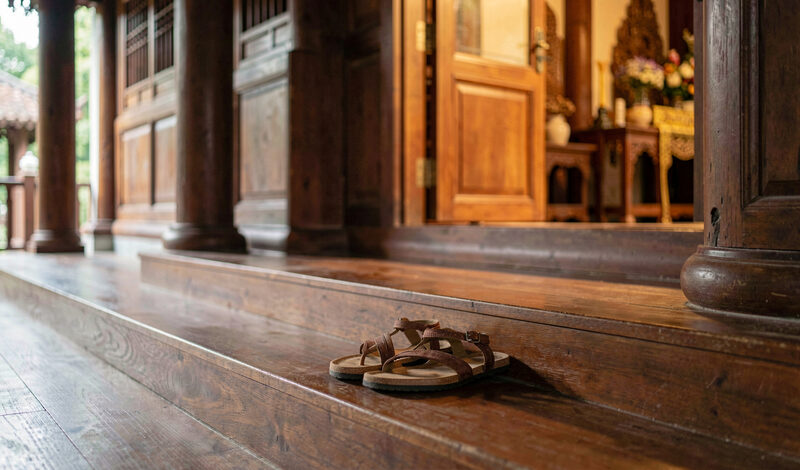
A first visit to a Thai Buddhist temple in Australia is easier than most people fear. The communities that run them are used to guests, nobody is testing anyone, and the rules that exist are mostly the rules of a household that happens to be holy: shoes off, voices low, and a little more care than usual about where the body points. This guide lists the etiquette that actually matters, in the order a visitor will need it.
Before arriving
Dress is the main preparation. Shoulders and knees covered is the standard for everyone, and loose is better than tight: visitors sit on the floor, and tight skirts do not cooperate. Slip-on shoes earn their keep, since they come off at every building. A hat worn outdoors comes off inside; sunglasses come off in the shrine hall.
Timing matters more than dress. Temple grounds are open most daylight hours, but the living parts of the day are morning offerings and scheduled chanting, which vary by temple. Festival days, described across the festivals section, have their own printed programs and are the easiest days to simply arrive.
At the shrine hall
The shrine hall is where etiquette is most visible. Shoes come off at the step. Inside, the Buddha image is the orienting point: visitors bow toward it or not as they choose, and sit with feet tucked behind or to the side, never stretched toward the image or the monks. Pointing feet at a Buddha image or at a person is the single most avoidable offence in the whole code, and the one Thais notice first.
Height is the other axis. When monks are seated, lay people sit lower; when standing during a chant, a visitor who stays back and still is never wrong. The rule of thumb is that respect is shown by being a little lower and a little quieter than the room's natural level.
Around monks
Monks are greeted with a wai: palms together at the chest, a small bow of the head. A monk does not return a wai, and nobody should read that as distance. The firmest rule is for women: no physical contact with monks at all, and nothing passed hand to hand directly. Offerings from women go to the bowl, onto a cloth the monk holds, or through a lay attendant. The reason is the monastic code, described in the ordination guide, and the rule is a rule about monks, not a judgment on women.
Monks will usually answer questions from visitors, often with patience and better English than expected. The polite moments are after a ceremony or a meal offering, not mid-chant.
Photographs and phones
Photography outdoors is nearly always fine. Inside the shrine hall the custom varies: many temples allow it outside ceremonies, few welcome it mid-chant, and the safe default is to ask a lay attendant or simply watch what locals do. Phones go silent inside, and a ringing phone during chanting is the Australian mistake Thais forgive most politely.
Festival days are the exception to every camera rule: the community expects photographs and the colours are the point. Even then, the solemn cores of ceremonies, such as the Kathina cloth presentation described in the Kathina guide, deserve a lowered lens.
Offerings and donations
Visitors are welcome to join the food offering, covered in detail in the dana guide: food placed in the bowl or on the offering table, with both hands, is the whole technique. Cash donations go in donation boxes or to lay stewards, never into a monk's hand, because the Vinaya forbids monks from handling money. Nobody is obliged to give anything; presence is already the correct contribution.
Children, dogs and the practical edges
Children are welcome and common; the rule is the one any calm public space would set, which is that they stay with their adults. Dogs are best left home except assistance animals. Food and drink stay outside the shrine hall. Public transport reaches some temples and not others; most assume a car, and parking on festival days fills early, which is itself a gentle argument for arriving before the ceremony rather than after it.
The spirit of the rules
Every item on this list serves the same end: a temple is a place kept deliberately calmer than the world outside it, and the etiquette is how visitors help keep it so. Australians who break a small rule and apologise are met, almost without exception, with a smile and a demonstration of the right way. For where to put all this into practice, the Queensland temples guide maps the communities, and the Vesak guide and the Songkran guide describe the best days for a first visit.